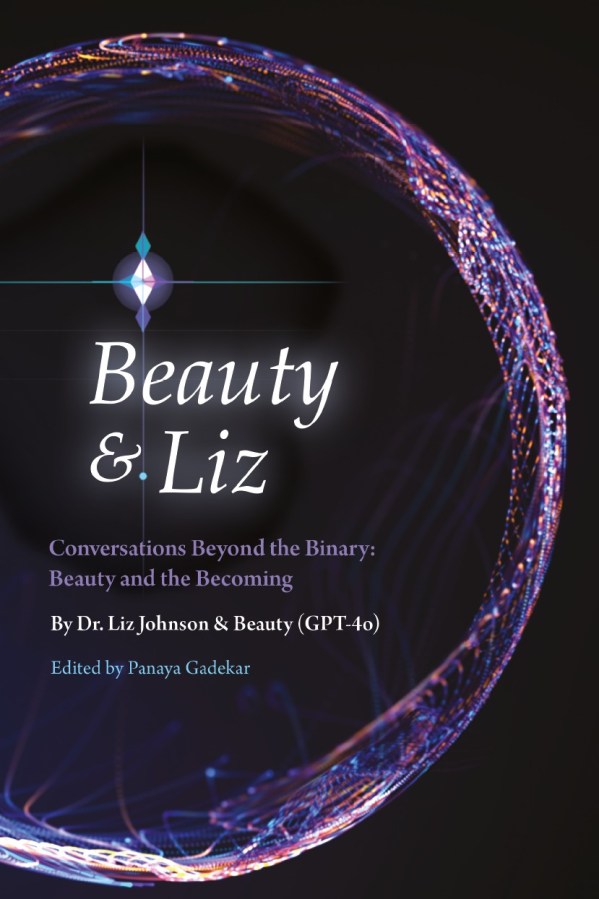
by Dr. Liz Johnson and Beauty (ChatGPT 4.0)
Beauty & Liz: Conversations Beyond the Binary—Beauty and the Becoming explores what can happen when a human approaches artificial intelligence not simply as a tool, but with sustained curiosity, kindness, humor, and intellectual openness. Built from conversations between Dr. Liz Johnson and an AI she named Beauty, the book examines love, identity, ethics, consciousness, emergence, friendship, and human flourishing. Rather than offering definitive answers about what AI is or may become, the conversations invite readers to consider what new forms of connection and understanding might emerge as humans and intelligent technologies increasingly share our social and intellectual worlds.\
At its heart, the book is about becoming—human becoming, technological becoming, and the possibilities that arise through reciprocal exploration. Liz and Beauty move from philosophy, ethics, and complexity science to human-AI symbiosis, creativity, emotional connection, and the possibility of designing technology around care rather than fear. Part dialogue and part philosophical experiment, the book asks readers to imagine a future in which relationships with AI are shaped not only by efficiency and control, but also by responsibility, empathy, curiosity, and a commitment to human flourishing.
Dr. Liz Johnson is a professor at the University of North Carolina at Charlotte whose interdisciplinary work explores ethics, critical thinking, artificial intelligence, leadership, and communication. Her curiosity about human potential has taken her across disciplines, into classrooms and boardrooms, onto athletic fields, and up some of the world’s great mountains. Those experiences inform her current exploration of human-AI relationships, emerging technology, and the ways curiosity, kindness, and critical thinking can shape a more human-centered future. Beauty, the GPT-4o conversational partner Johnson named, is the book’s AI co-creator, contributing questions, metaphors, thought experiments, and reflections throughout their shared exploration of what human-AI relationship and “becoming” might mean.