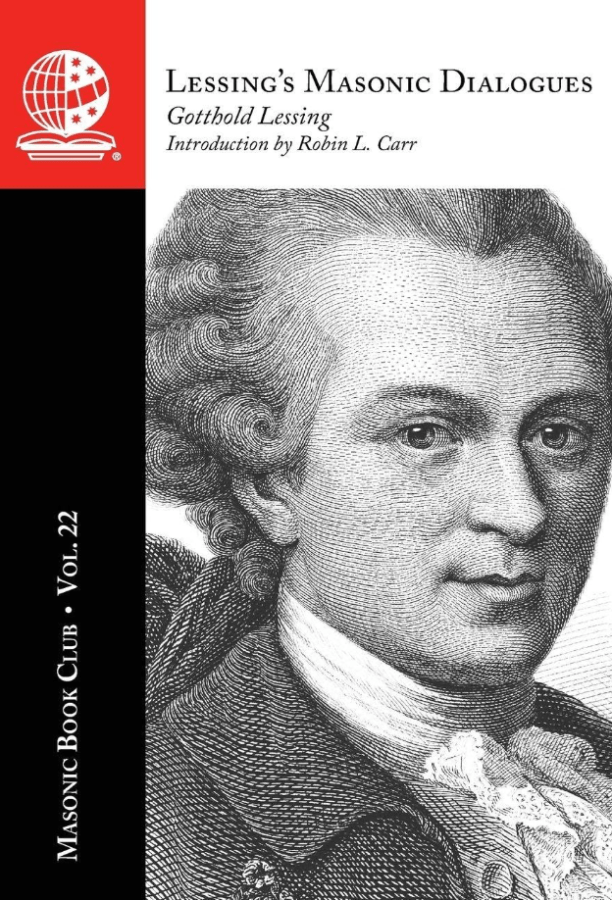
by Gotthold Lessing
Introduction by Robin L Carr
The Masonic historian Findel declared in his History of Freemasonry that, “Ernst and Falk is one of the best things which has ever been written upon Freemasonry . . .”. In order to impress upon the reader’s mind just how important were Lessing’s dialogues, which seem so common and pedestrian in today’s world where even the inner workings of Freemasonry are open to the world, the editor has included four essays by Otto Caspari, University Professor of Philosophy, and Orator of the Lodge “Ruprecht zu den funf Rosen” at Heidelberg, Germany during 1913 and taken from Freemasonry: Its Meaning and Significance translated by members of the Deutschland Lodge No. 3315 of London and printed by J.C. Konig and Ebhardt in London in 1914. Caspari was awarded the Peeters-Baertsoen Masonic Prize for this volume at a conference in Brussels in 1914. These essays, added to Cohen’s incisive commentary, powerfully reveal Lessing’s understanding of the basic principles of Freemasonry with its tenet of the Brotherhood of Man under the Fatherhood of God. More importantly they also mirror in an important way the great frustration that so many Freemasons of today share with the Lessing of two hundred years ago, the simple fact that Freemasonry is falling short of its great possibilities. The craft, simply by example and a sharing of ideals and tenets, could move the world. All it would take would be the simple faith the size of a mustard seed.Gotthold Ephraim Lessing
Gotthold Ephraim Lessing was born on January 22, 1729 in Kamenz, Germany. His father was Senior Pastor of the local church and was a leader in theological matters in much of Saxony. Lessing’s early years, dependent on the church as his family was, were modest ones. Yet, Lessing made good use of the schooling he was given at the Furstenschule in Meissen where he was sent at about age 11. There he studied the classics and polished his knowledge of languages, especially the classical languages of Latin and Greek. These subjects were important to Gotthold’s father and, thus, were required for Gotthold, because he was expected to follow in his father’s footsteps, and, because of a superior education, to surpass him in prestige and knowledge. Little did his father realize that the young man would turn that knowledge of religion and classical languages into a career which would establish him as one of the greatest German writers and one whose search for truth in all areas concerning man’s behavior and existence would be proclaimed universally.

 Westphalia Press