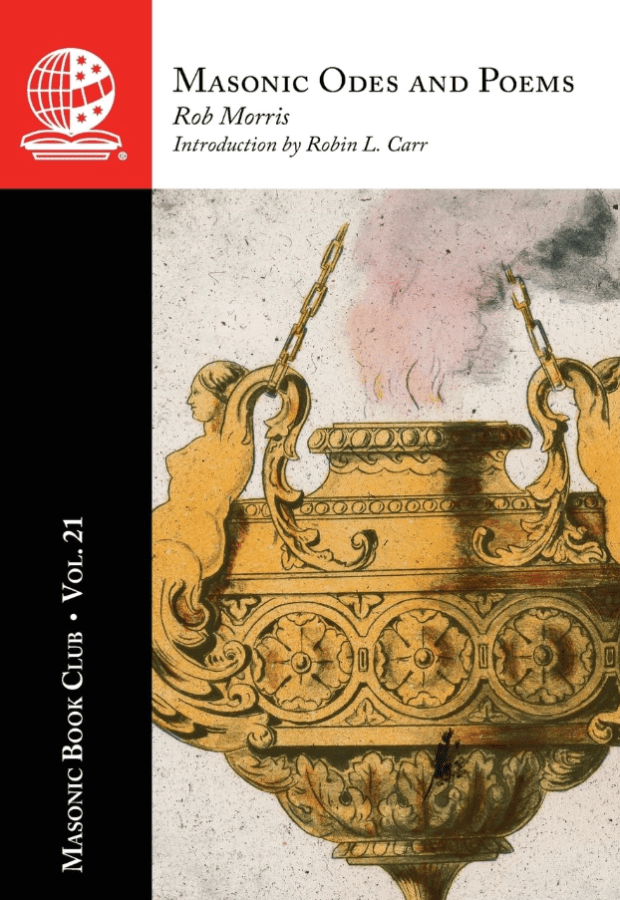
by Robin L Carr
It wasn’t long before he adopted the Morris name and became a part of that family. Several years later, when he began his prolific writing career, Robert Williams Morris decided to change his first name to Rob so as not to be confused with the famous Robert Morris of Revolutionary fame. Of his younger years we know little, but the young man soon became a teacher at the Sylvan Academy in Oxford, Mississippi where he petitioned and joined Oxford Lodge No. 33 being raised to Master Mason on March 3, 1845. It seems that in that place young Rob developed a love for the principles and ritual of Freemasonry for he joined and received all the degrees in both the York and Scottish Rites and began to lecture about the craft. Just thirteen short years later Rob Morris was the Grand Master of Kentucky, 1858-59. Although Morris taught in the schools of Kentucky and Mississippi, he was a civil engineer and geologist by profession and a soldier when ever needed. Yet, it would seem that he actually made his livelihood by teaching and writing about Freemasonry. His travels were legend. He traveled throughout all of the United States and through much of Canada. He visited the Holy Land and established a Lodge in 1873 in that land. It was called Royal Solomon Lodge and it was said that Rob Morris became its first Worshipful Master in 1873 in a ceremony held in what was purported to be “King Solomon’s Quarry” beneath the city of Jerusalem. This Lodge which was chartered under the Grand Lodge of Canada stumbled along for several years and finally closed its doors in 1907.
Rob Morris was growing in prominence. He was receiving honors, traveling and lecturing widely. His was going to be a Masonic Career of eminence. But then, according to Coil, Morris made a blunder which stunted his career and altered his goals. This blunder was his attempt to promote the Conservators of Symbolic Masonry which most historians agree was an overly ambitious plan to unify the Masonic Fraternity in the United States and to formally adopt a single ritual for all of the country. That ritual would have been the famed Webb-Preston Ritual. The fraternity was not ready for unification nor codification. All of Morris’ time for most of a decade was tied up in the conservator movement. Nothing else was to be derived from his great talents during that time and a good Masonic poet, as Morris was, could have done much to record the Masonic presence during the great Civil War. Another, related project at this time was Morris’ attempt to establish once and for all just what the GREAT LANDMARKS of Freemasonry were. He developed a list of 17 and printed them in his 1856 volume, Code of Masonic Law.