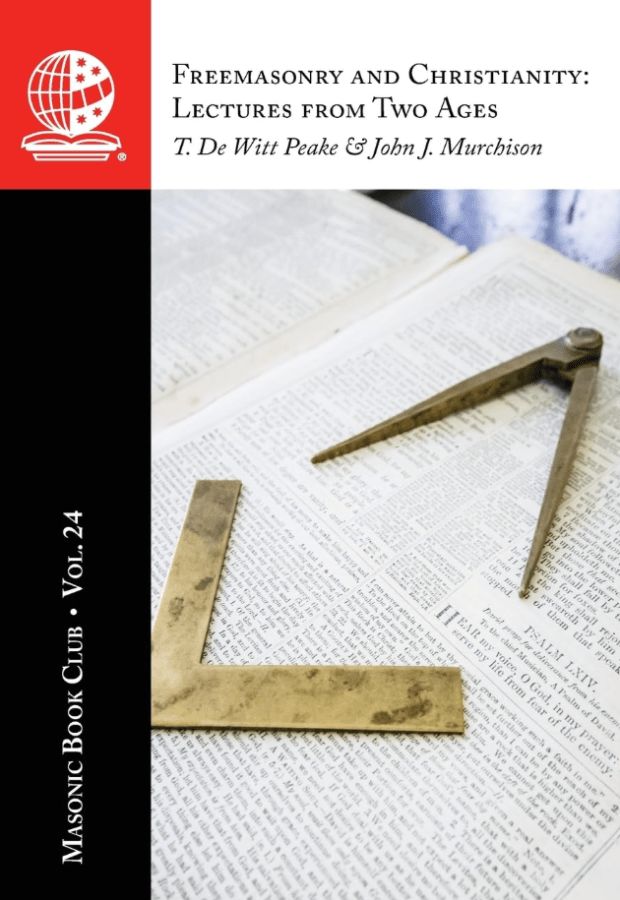
by T de Witt Peake and John J Murchison
The selection of the Masonic Book Club for 1993 consists of two little books on Masonic morals and philosophy. The first, The Symbolism of Solomon’s Temple, was written by Rev. T. DeWitt Peake a century ago, being made up of four lectures or sermons first given from the pulpit of his Methodist Episcopal Church and then printed at the request of the Masons of the area “for the instruction of the craft at large.”
The second volume, From The Chaplain’s Station, is from our own era and is made up of a collection of mini-lectures on Masonic morality and virtue given by Chaplain and Past Master John J. Murchison each meeting throughout the year “that he might have pleasure and the craft profit thereby.” P. M. Murchison asked that the book not be copyrighted so that Masons might be free to take these thoughts and use them “for the betterment of mankind.”
These books are strikingly similar in many of their admonitions and conclusions. As we learn in The Holy Bible that God is the same “yesterday, today and forever,” so the basic tenets and lessons of Freemasonry have a consistency from one century to the next.
The topic of Masonic Morality and its relationship to religion is of interest to our craft apropos the current attacks from many directions, especially by “fundamentalists” who claim that Freemasonry is not only a religion, but is also antagonistic to their “true” religion. Many Masonic brethren are aware that facets of one major denomination have actually gone to the point of calling all Masons to leave their church membership. Such action is unthinkable if Masonry is wholly understood.
In the words of Albert Mackey, Masonic author of a century ago often quoted (and misquoted) by these radicals, Masonry is a religious institution in that “it teaches a belief in God and a practice of moral duties.” One cannot speak of the “Masonic Religion” as one mentions the Christian Religion or Mohammedanism. The teaching of fundamental truth does not make Freemasonry a religion, as brethren of different religions attending the same lodge in amity will assure you. However, these enemies of the craft, through ignorance or stubbornness, go blithely on their venomous way.