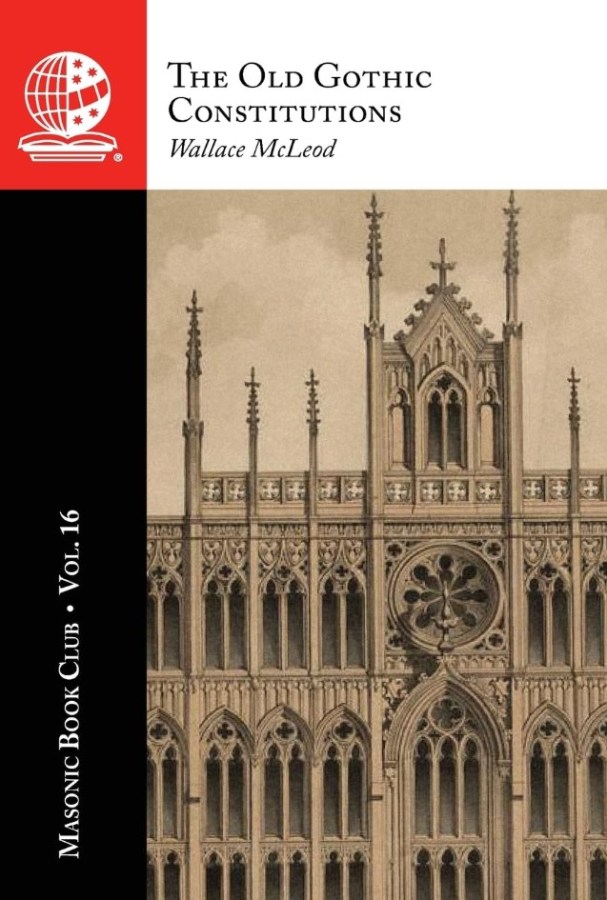
by Wallace McLeod
When Alaric, the Visigoth, swept down from the North in A.D. 410 to sack the Immortal City of Rome, it marked the advent of the Dark Ages in the civilized world of Greece and Rome. It is strange to recall that out of the barbarism and savagery associated with the name Gothic, there arose an architecture of a new and unfamiliar beauty, producing cathedrals that would express man’s highest aspirations in his quest for the Supreme Architect of the Universe.
When the Reverend Dr James Anderson wrote his landmark Book of Constitutions in 1723, he referred to and relied on a series of old manuscripts that were in his hands, which he named the “Old Gothic Constitutions.” This title was not intended as a compliment, for Anderson and his contemporaries did not yet appreciate the beauty of the Gothic legacy. Rather, he was trying to show that in these manuscripts he had a tangible link with those old Masons who lived in medieval days when the cathedral building craze was sweeping across Western Europe.
The word “Gothic” brings to our minds the flying buttress, the pointed arch, the soaring spire, and all the elaborate and beautiful ornamentation, which even after so many years can still excite wonder and admiration in the architects and engineers of today. And so the name “Gothic Constitutions” carries with it a notion of antiquity combined with enduring worth, which is entirely appropriate as we search for the ancestry of our great Fraternity.
Here, in this volume, is a story that most Masons have never dreamed of, much less encountered. It delves into our Masonic background in a manner that will appeal primarily to the scholar and historian; happily, there is a bit of both in each of us. When the manuscript of this book first came into our hands we were pleasantly surprised by the depth of research – the hundreds of hours spent in detailed comparison. In this one volume are the results of years of study. It has not been done before; it will never need to be done again. It illuminates a branch of Masonic study that is esoteric and little known, but tremendously significant as we ponder our rich heritage. Nor can it be grasped in one quick reading. But it is here for us to read, study, consider, and read again, as we recall how firm a foundation our Masonic ancestors laid for our own spiritual temples.